Truckload Break-Even Math: How Many Bin Days Until a Load Pays Off
You signed for the pallets, cut the wrap and filled the bins. Now comes the step most new operators skip: working out which day the load stops being a risk and starts being profit. Without that number you're pricing by feel, and feel runs optimistic on Friday and panicked by Wednesday.
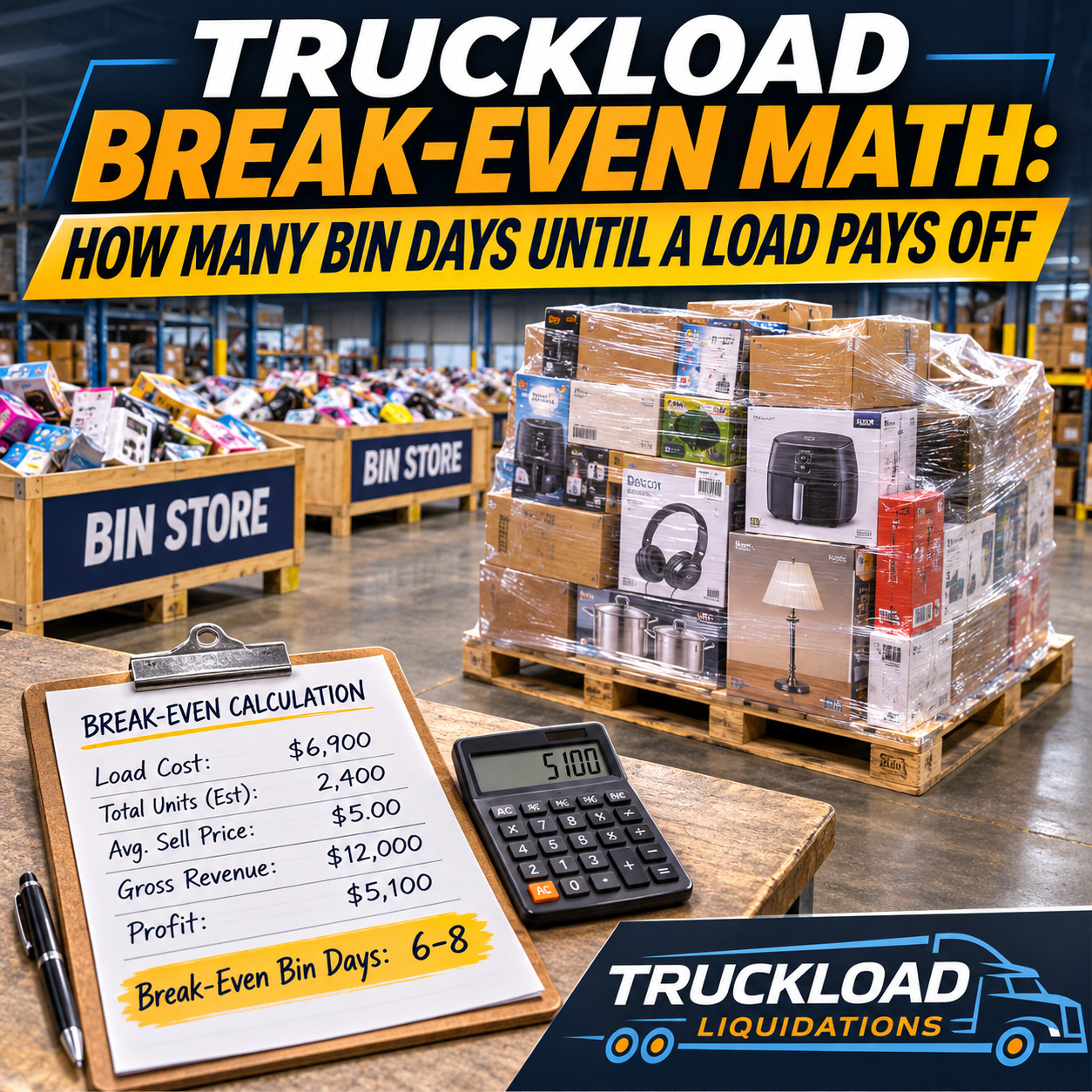
Truckload break-even is the day your cumulative sales cover what the load cost to land, plus the overhead it used while sitting on your floor. Three inputs get you there: landed cost, sell-through by price-drop day, and fixed costs per bin day. Every figure below is an example to show the method. Swap in your own register data before you rely on any of it.
What truckload break-even actually measures
Margin tells you how a load ended up. Break-even tells you when it got safe. Those are different questions, and the second one is what protects your cash. If a load needs seven bin days to cover itself but your schedule only runs five, you already know it's a loser before you buy it.
The formula is simple: break-even revenue = landed cost + (fixed cost per bin day × bin days). You find the day where cumulative sales cross that moving line. A mixed general merchandise truckload is a good place to practice because the variety of items tends to spread sales across several price points instead of depending on one hot category. When you're ready to test real numbers, the current truckload specials give you loads and pricing to plug straight into the formula.
Step one: get landed cost right
Landed cost is everything between you and a pallet sitting in your back room. That means the load price, freight, any delivery fees, and the labor to unload and stage it. People forget the last two, then wonder why the load felt thinner than the spreadsheet said.
Here's an example load. Load price: $6,000. Freight: $1,100. Delivery fees: $175. Unload and staging labor: $250. Landed cost: $7,525. The manifest shows $36,000 in retail value across 1,800 units, so landed cost is about 21% of retail, or roughly $4.18 per unit.
Delivery fees are where surprises hide. Liftgate service, residential delivery and appointment scheduling can each add a line to the bill, so it pays to know the liftgate, residential and appointment fees to ask about before you book. Get the freight quote and fee list in writing first, then build the number.
Step two: estimate sell-through by price-drop day
Retail value is a reference point, not revenue. What matters is how many units leave the bins at each price. If you run a descending schedule, every day has its own price and its own sell-through rate, and the early days carry most of the weight.
For this example, say the schedule runs six days with these average prices and shares of the original 1,800 units. Day 1 at $10: 25% sells (450 units). Day 2 at $7: 20% (360). Day 3 at $5: 15% (270). Day 4 at $3: 10% (180). Day 5 at $2: 8% (144). Day 6 at $1: 6% (108). These are illustration numbers, not benchmarks. Your own register history by day is the only data that counts.
If you haven't built a schedule yet, this breakdown of how weekly price drops protect margin covers the structure behind the daily price steps. Whatever schedule you use, record units sold per day per load. Two or three loads of tracking will give you far better inputs than any guess.
Step three: charge the load for its fixed costs
A load isn't free to hold. It takes up floor space, bins and staff attention every day it's on display. Ignore that and every load looks profitable the moment sales pass the purchase price, which is how stores stay busy and still run short of cash.
Start with your total daily overhead: rent, utilities, payroll, insurance, software and card processing. Then assign the load a share based on the floor space or bins it occupies. In the example, daily overhead is $800 and this load fills a quarter of the floor, so it carries $200 per bin day. Keep unload labor in landed cost so you don't count it twice.
The share doesn't need to be exact. It needs to be consistent, so you can compare one load against the next on the same basis.
Putting it together: the day this load pays off
Now run the cumulative numbers. Cumulative cost starts at $7,525 and grows $200 each day: $7,725 after Day 1, $7,925 after Day 2, $8,125 after Day 3, and so on. Cumulative sales run $4,500 after Day 1 (450 × $10), $7,020 after Day 2, and $8,370 after Day 3.
After Day 2 the load is still $905 short. During Day 3 sales pass cost, so truckload break-even lands late on Day 3, with about a $245 cushion by close. Days 4 through 6 add $540, $288 and $108, bringing six-day sales to $9,306 against $8,725 in cost. That's roughly $580 of profit before any leftovers, and 288 unsold units (16%) are still available for bulk lots or a final clearance.
Here's a quick per-unit check. The 1,512 units that sold needed to average about $5.77 each to cover costs. They averaged about $6.15. If you can't hit your required average price on paper, the load won't hit it on the floor.
Alan’s Rule: Aim for break-even by the halfway point of your price-drop schedule. Anything that sells after that is profit and cushion, not rescue money.
What moves break-even the most
Run a few what-ifs before you buy, because small misses compound. Take the example and drop Day 1 sell-through from 25% to 20% with everything else unchanged. Six-day sales fall to about $8,406 against $8,725 in cost, and the load is underwater. A five-point miss on the first day erased the whole profit.
Purchase price works the other way. Negotiate $500 off the load and landed cost drops to $7,025, which pulls break-even forward by almost half a day. Freight is similar. A tighter delivery fee list or a better lane can matter as much as a better manifest, so get a truckload shipping quote before you commit to the load itself.
Load type matters too. Operators comparing sources often start with bin store trucks because the mix is meant to move through a bin format. Whatever you buy, track actual daily sales against your plan. After a few loads you'll know your real Day 1 number, and that is the single most useful input in the whole model.
About Alan C.
Alan C. is a veteran of the secondary market with over a decade of experience in high-volume inventory procurement. Specializing in the logistical complexities of truckload-scale reselling, Alan has built a reputation for helping businesses scale beyond individual pallets into full-trailer operations.
Read More About Alan →More Related Posts