Liftgate, Residential and Appointment Fees on a Truckload: What to Ask Before You Buy
You get a freight number, it looks fair, and you buy the load. Then the invoice shows up with a liftgate line, a residential line and maybe a redelivery charge. Nobody hid anything. Nobody asked you the right questions either. These truckload accessorial fees are the most common reason a cheap load turns out not to be cheap.
The good news is that most of them are predictable. If you can answer a handful of questions about your delivery site before you request pricing, the quote you get is much closer to the bill you pay. Here is the pre-quote checklist I'd run through every time, with what to tell the carrier and what to ask back.
Why the quote and the invoice rarely match: truckload accessorial fees explained
A base freight rate assumes a simple job. The truck picks up at a commercial dock, drives to a commercial address that has a dock or a forklift, and unloads within a reasonable window. Anything outside that picture is an accessorial: a separate charge for extra service, extra equipment or extra time.
That matters most when you're comparing truckload specials, because the load price is only half of your landed cost. A load that looks $300 cheaper than another can lose that gap on freight extras alone. As an example only, a liftgate might add $75 to $150, a residential delivery $100 to $200, an appointment $25 to $75, and detention $50 to $100 per hour after free time. Rates vary by carrier and region, so treat those as ballpark ranges, not quotes.
Stack three or four of those on a single delivery and you've added several hundred dollars you never budgeted. Multiply that across a month of buying and it shows up in your margin.
Liftgate: the real question is your unloading setup
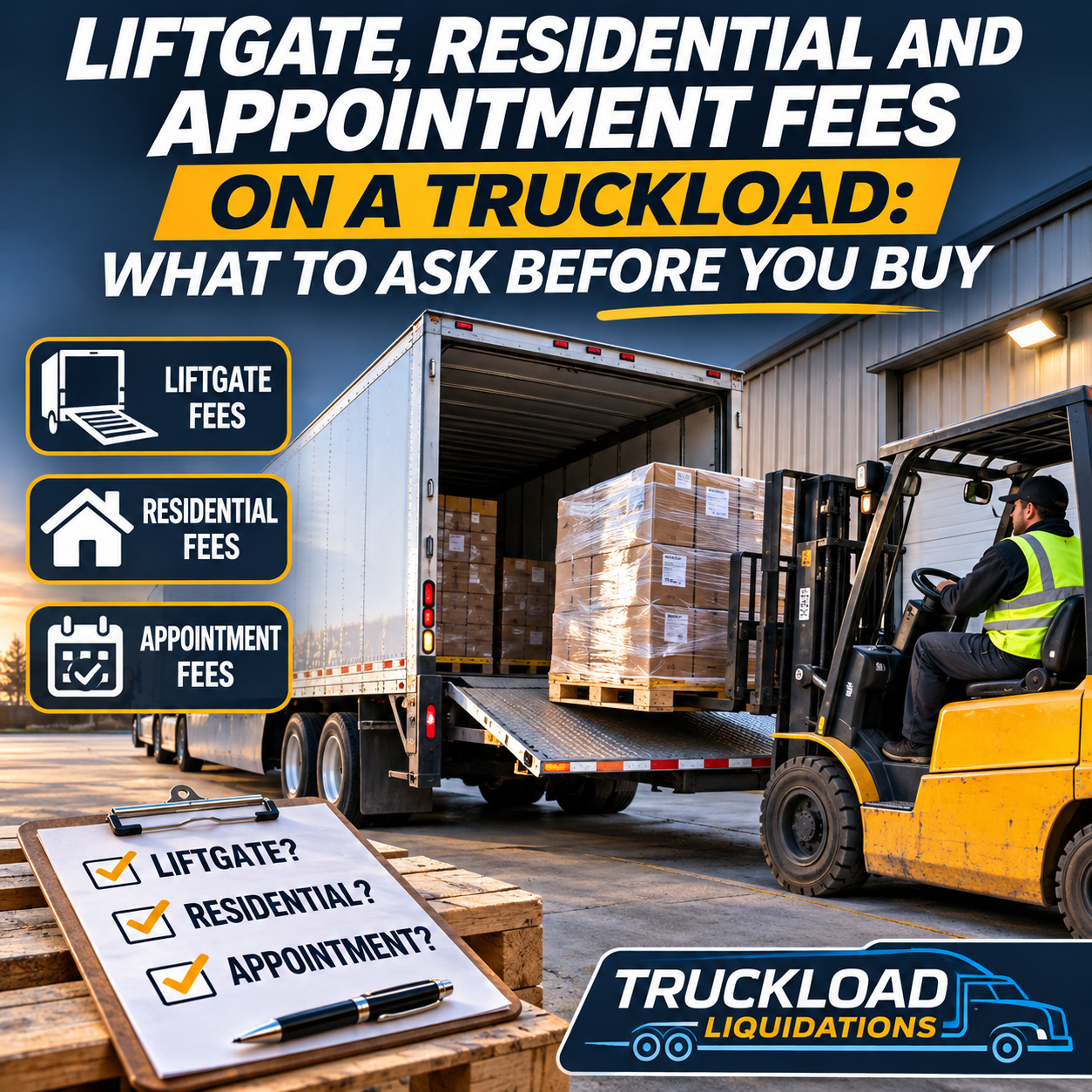
A liftgate is a hydraulic platform on the back of the truck that lowers freight to the ground. You need one when you have no loading dock and no forklift. You don't need one if you have a dock at truck height or a forklift that can pull pallets straight off the trailer.
Here's what trips people up. Many full-size trailers don't have liftgates at all, so asking for one can change which carrier can haul your load, and sometimes the price of the whole move. Ask the carrier up front whether they can do the delivery with the equipment you actually have, not just what the fee will be.
Weight matters too. Liftgates have rated capacities, and heavy pallets can push past them. If you're buying tools trucks, ask for the approximate weight per pallet and tell the carrier before they dispatch. Power tools, hand tool sets and hardware are dense, and a pallet that looks normal can be far heavier than a pallet of household goods.
Residential and limited-access delivery
Carriers classify a delivery address, and the classification drives the price. A storefront in a retail strip is commercial. A home, a farm, a storage unit, a church, a school or a construction site is often treated as residential or limited access, and those carry extra charges.
Plenty of bin store owners and resellers start out receiving freight at a garage, a barn or a shop behind a house. That's fine. What's not fine is telling the carrier it's a business address when the driver pulls up to a residence. The reclassification fee tends to be higher than the fee you'd have paid by disclosing it, and it can come with a failed delivery.
Also think about the road. A 53-foot trailer needs room to turn, back up and stay on firm ground. If your site has a narrow drive, low trees or a soft lot, say so. One workaround is to meet the truck at a nearby commercial lot with a forklift and shuttle the freight in your own vehicle. It costs you time but can save a limited-access charge.
Inside delivery and appointment fees
Inside delivery means the driver brings freight past the threshold of the building, rather than leaving it at the back of the truck or at the curb. On a full truckload, it's unusual and often not offered, since a driver generally doesn't unload a trailer by hand. Don't assume it's included, and don't assume it's available. Ask who is responsible for unloading, how, and with what equipment.
Appointment fees cover the carrier scheduling a delivery window with you. Some carriers include a call-ahead; others charge for a set time slot. If you need a specific day or a narrow window, ask whether that costs extra and what happens if the truck is early or late. A related line is a notification fee, which is just the driver calling you before arrival.
If you're running a one-person operation, tell the carrier your receiving hours honestly. A delivery that arrives while you're closed turns into a redelivery charge and a lost day.
Detention and layover: the fee that hurts most
Detention is the charge for keeping the driver and truck waiting. Most carriers give a block of free time at delivery, commonly around two hours, then bill by the hour after that. The clock starts when the truck checks in, not when you're ready to start unloading.
Here's a worked example with made-up numbers. Say the free time is two hours, the truck arrives at 9:00 a.m., and your forklift operator doesn't finish until 1:30 p.m. That's 4.5 hours on site, so 2.5 hours are billable. At an example rate of $75 an hour, you owe $187.50 on top of the freight. If the driver then runs out of legal driving hours and has to wait overnight, a layover charge may follow.
Alan's Rule: If a fee could apply to your delivery, get it in writing as either a dollar amount or "not applicable" before you agree to the freight. A vague "accessorials may apply" is not a quote.
Alan’s Rule: If a fee could apply to your delivery, get it in writing as either a dollar amount or "not applicable" before you agree to the freight. A vague "accessorials may apply" is not a quote.
The pre-quote checklist: what to have ready
Before you request pricing, write down the answers to these. First, the address type: commercial, residential, storage facility or other limited-access site. Second, your unloading equipment: dock, forklift or nothing, and whether the forklift can handle full pallets. Third, your receiving hours and the days you can take a truck.
Fourth, the load details: approximate pallet count, pallet weights, and whether the freight is tall or stacked. Fifth, your realistic unloading time, including who's on site and how long you need. Sixth, any access limits such as gates, tight turns, low clearance or soft ground.
With those answers in hand, submit a truckload shipping quote request that lists every item and ask for a line-by-line breakdown, including free time and the hourly detention rate. Then compare quotes on landed cost, not on the base rate.
Finally, put freight in context with the rest of the purchase. Our guide on the six checks to run before paying for a discounted load covers what to verify on the merchandise side, so you aren't only optimizing the shipping line while missing a problem with the load itself.
About Alan C.
Alan C. is a veteran of the secondary market with over a decade of experience in high-volume inventory procurement. Specializing in the logistical complexities of truckload-scale reselling, Alan has built a reputation for helping businesses scale beyond individual pallets into full-trailer operations.
Read More About Alan →More Related Posts