Truckload Specials: 6 Checks Before You Pay for a Discounted Load
A banner that says 20% off a load feels like a win. Sometimes it is. Other times you pay a lower sticker price and end up with a worse margin, because the freight was higher, the mix was wrong for your shoppers, or half the pallets sat for four months.
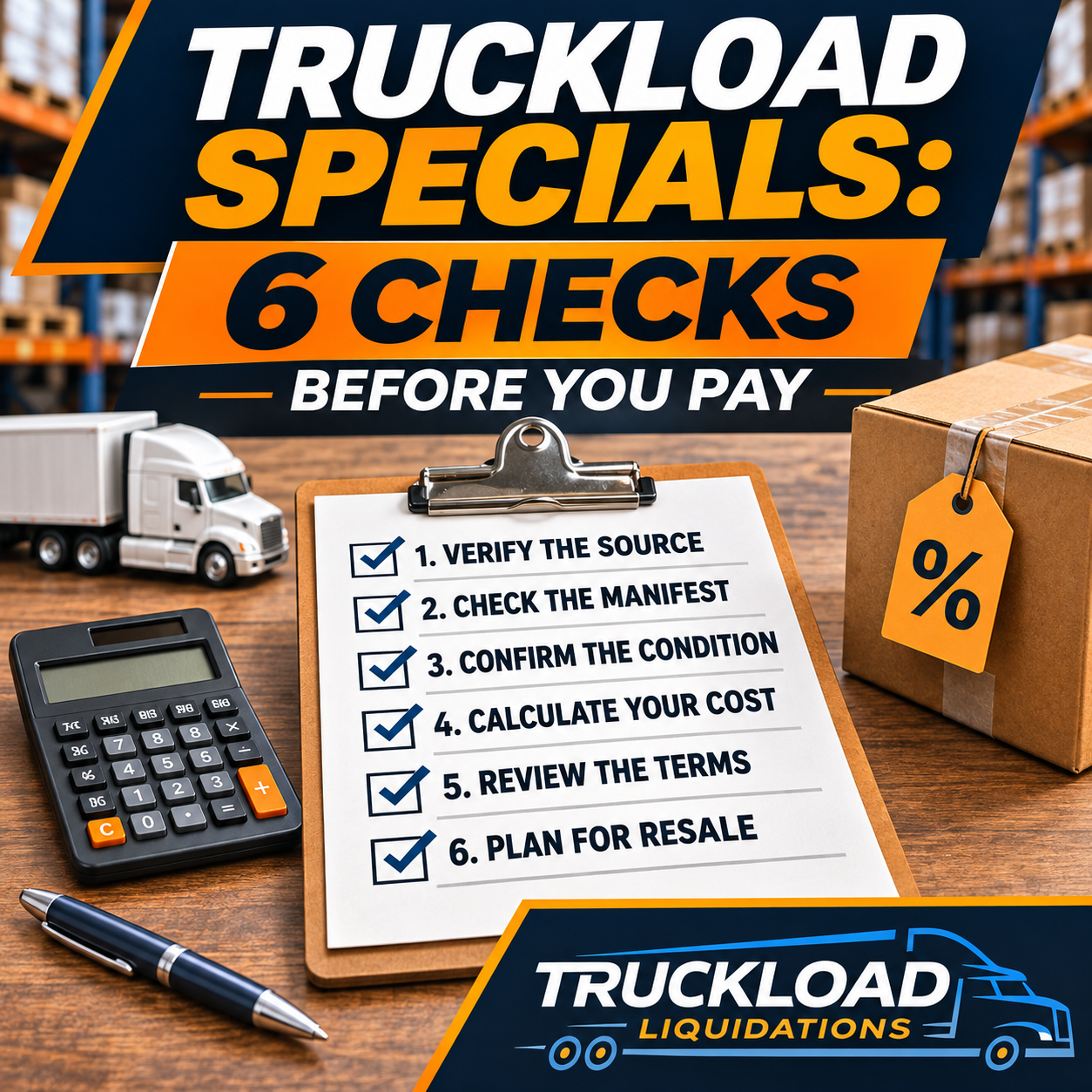
The fix is a short test you can run in ten minutes before you commit. This post gives you six checks for comparing a special to the normal price, so you judge the deal on what you actually keep after the load sells, not on the discount percentage.
Why truckload specials need their own math
A discount only tells you how the seller's price changed. It says nothing about what the load costs you at your dock or what it brings in at your register. Two loads with the same retail value can produce very different results depending on what is on the pallets and how far they travel.
So the question is never "is this cheaper?" It is "does this load put more profit in my pocket than the one I would normally buy?" To answer that, you need a baseline. Pull the price, freight and typical sell-through from your last regular load, then hold each of the current truckload specials up against it.
If you run a bin store, your baseline is probably a mixed load of general merchandise that you know how to price and rotate. Look at how bin store trucks are usually put together, and compare any special to that kind of mix rather than to a vague idea of retail value.
Checks 1 and 2: Freight and load mix
Check 1: Landed cost. Add freight to the load price before you compare anything. A special that ships from the other side of the country can cost more at your dock than a full-price load that ships 300 miles. Freight on a full truckload is often a meaningful chunk of the total, so ask for the delivered number, plus any liftgate, appointment or residential fees your location triggers. Then divide landed cost by the number of units or pallets so you can compare across loads of different sizes.
Check 2: Load mix. Ask what the load is made of, and be honest about whether those categories move in your store. Heavy, bulky items like furniture, large grills or fitness equipment take floor space and sell slower in many bin stores. Small, repeat-buy items such as home goods, toys, kitchen items and health and beauty tend to turn faster at bin pricing.
If your customers hunt for brand names and online-marketplace returns, a special built around amazon truckloads may fit better than a generic mix. If your crowd skews toward contractors and DIY buyers, tools-heavy loads might be the better match. A discounted load that doesn't match your shoppers is not a discount.
Checks 3 and 4: Condition and sell-through
Check 3: Condition and paperwork. Find out what condition grade the load carries: new, open box, customer returns, shelf pulls or a mix. Ask whether a manifest is provided and how detailed it is. A load priced low because it is mostly damaged or missing parts is cheap for a reason. A manifest lets you spot the SKUs you can price quickly and the ones that will need testing, repair or a trip to the dumpster.
Check 4: Sell-through speed. Cost per unit only matters if the units leave your building. Think about how long your last load took to clear and how many weeks of floor space a new one will tie up. A load that sells through in six weeks and one that takes fourteen can have the same gross margin on paper, but the faster load lets you reinvest sooner and buy twice as often.
A simple habit helps here. Track your average sell-through by category for a month or two. Even a rough tally on a spreadsheet will tell you whether toys beat housewares or whether apparel sits. Then weigh each special's likely mix against your own numbers instead of the seller's description.
Checks 5 and 6: Cash tied up and repeatability
Check 5: Cash and timing. A special often comes with pressure: limited quantity, short window, payment up front. That is fine if the numbers work, but do not stretch your cash so far that you cannot restock on time. Money stuck in one slow load can make you miss the next good one. Decide in advance the most you are willing to have tied up in any single truck and stick to it.
Check 6: Repeatability. Ask whether you could buy this exact kind of load again at a similar price. A one-off special can help your cash flow, but it can't be the foundation of your buying plan. If the product mix is consistent and the seller can supply it regularly, the deal is more valuable than a single lucky pallet run. If it is a one-time surprise, price it as a gamble and treat any upside as a bonus.
A worked example with made-up numbers
These figures are for illustration only, so swap in your own. Say your usual load costs $5,000 and freight to your dock is $600, so landed cost is $5,600. From past loads, you expect to bring in about $7,000 at your bin pricing. Your gross profit is $1,400.
Now a special appears at $4,200, which looks like a 16% cut. But it ships farther, and freight comes to $1,500. Landed cost is $5,700, already more than your normal load. The mix is also heavier on bulky items, so you estimate sales of $6,300 instead of $7,000. Gross profit drops to $600, less than half of your baseline.
Change one thing and the answer flips. If that same special had freight of $700 and a mix close to your normal one, landed cost would be $4,900 and revenue $7,000, for $2,100 in gross profit. Same sticker price, completely different result. That is why you run the checks instead of reacting to the percentage off.
Alan’s Rule: A special beats the normal price only if landed cost per sellable unit is lower and the load will clear in about the same time as your usual one.
When the normal price is the better buy
Pass on the special if freight eats most of the discount, if the mix pulls you into categories you don't sell, or if the manifest is vague enough that you can't estimate resale. Pass if the purchase would leave you short on cash for your next regular load. There will be another deal next month.
Buy the special when your landed cost per unit comes in clearly below the baseline, the mix looks like what your customers already buy, and you can sell it without crowding out other inventory. Write down the numbers each time, win or lose. After five or six loads, you will see patterns that no discount banner can hide.
About Alan C.
Alan C. is a veteran of the secondary market with over a decade of experience in high-volume inventory procurement. Specializing in the logistical complexities of truckload-scale reselling, Alan has built a reputation for helping businesses scale beyond individual pallets into full-trailer operations.
Read More About Alan →More Related Posts